The UK's long-standing capitalist tradition and history of industrial development have endowed it with a solid economic foundation and well-established commercial rules. Today, the UK, with the world's sixth-largest and Europe's second-largest GDP, not only boasts one of the world's most influential financial centers but also concentrates top-tier educational resources and research institutions, consistently maintaining long-term appeal for global investors.

Geographical Location
The United Kingdom of Great Britain and Northern Ireland is located on the British Isles in northwestern Europe, separated from the European mainland by the English Channel. It comprises England, Wales, Scotland, and Northern Ireland, with fourteen overseas territories. The main UK land area is approximately 244,100 square kilometers (including inland waters). As a typical West European island nation, the UK holds an advantageous geographical position, maintaining close ties with continental Europe while facing the world with an open posture.

Demographics
The total population of the UK is approximately 67.18 million, about three times that of Beijing. England is the largest constituent country by area, covering about 130,400 square kilometers. The capital, London, is not only the UK's largest city but also an international financial and cultural hub, with a resident population of around 9.1 million. Excluding London, the national average population density is only 340 people per square kilometer, while London's population density reaches 5,600 people per square kilometer, highlighting its unique agglomeration effect.。
English is the official language of the UK, with English as spoken in England and Scotland being the most widely recognized. At the same time, Welsh and Gaelic continue to be used in some areas (e.g., the Scottish Highlands, North Wales, parts of Northern Ireland),contributing to the UK's diverse linguistic landscape.
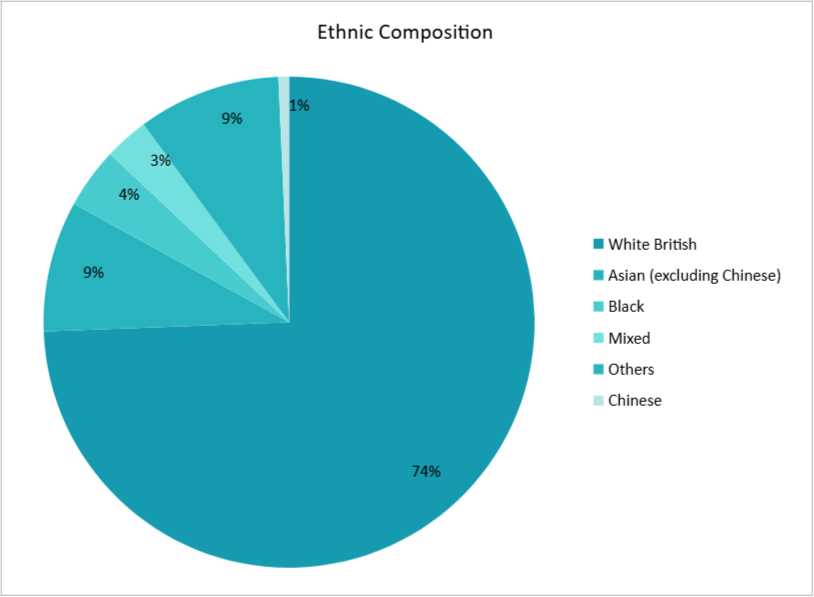
According to the 2021 census by the UK Office for National Statistics, the total population of England and Wales was 59.7 million. The White ethnic group accounted for 81.7% (including 74.4% White British), the Asian ethnic group for 9.3% (including approximately 0.7% Chinese), the Black ethnic group for 4.0%, and the Mixed ethnic group for 2.9%. London, as the most international city, saw its White British proportion drop to 36.8%, while the foreign-born population proportion rose to 40.6%, reflecting a vibrant and interwoven multicultural environment.
The religious landscape of British society is diverse and unique. Approximately 59% of the national population identifies as Christian, other religions account for about 11% (including Muslims at about 5%), and those with no religion are close to a quarter (25%) of the population. While major political parties are not overtly religious, the Church of England retains a historical presence within the political system: over 20 bishops sit as Lords Spiritual in the House of Lords, and the British monarch is also the Supreme Governor of the Church. The Prime Minister, while focused on governance, retains influence over some church appointments. This blend of tradition and modernity is a distinctive feature of British society under the constitutional monarchy.Overall, the UK is a truly diverse nation, with London at the forefront of multiculturalism. Different religions and ethnic groups coexist and integrate here, allowing outsiders to find more respect and fairness in the UK.

Time Zone

China-UK Flights
The entire UK uses Greenwich Mean Time (GMT), switching to British Summer Time (BST) during summer months.Air connectivity between China and the UK is well-developed. According to recent data, there are direct flights from 12 major Chinese hub cities to London, Manchester, and Edinburgh, with over 100 total flights per week. Flight duration typically ranges between 10 to 17 hours. Fares fluctuate significantly by season: off-peak economy class round trips start around RMB 2,000, while peak prices during summer/winter holidays and public holidays often exceed RMB 10,000. Business class fares during peak times are often charged at full price.

Economic Level
As the world's sixth-largest and Europe's second-largest economy, the UK's GDP in 2023 was approximately US$3.1 trillion, equivalent to about one-sixth of China's GDP. In the same period, the average annual disposable income per UK household was approximately £32,000 (equivalent to about RMB 262,000), indicating a relatively high standard of living.The UK economy is predominantly private-sector driven, contributing over 90% of GDP. Provided they meet regulatory requirements, private capital can enter almost all industrial sectors. For example, the Li Ka-shing family has made large-scale investments in UK infrastructure such as power, telecommunications, and water utilities, highlighting the open market environment.At the institutional level, the UK possesses a mature legal system and strict property protection laws, making it a consistent "safe harbor" for global investors. London stands alongside New York as one of the world's two leading international financial centers, further solidifying the UK's core position in the global capital markets.


Primary Education
The UK education system is divided into state and private sectors. State schools are free, have very high coverage, and about 93% of UK students graduate from state schools. Private school fees typically range from £15,000 to £40,000 per year, offer more diverse educational approaches, and enroll both domestic and international students.Within the state system, Grammar Schools employ selective exams for admission, comparable to key state schools. The UK's only two female Prime Ministers both attended grammar schools, underscoring their historical influence.While not synonymous exclusively with elite education, private schools show a clear overall academic performance advantage. For instance, in GCSE exams, 62.9% of private school students achieved grade A or above, significantly higher than the 20% in state schools. Among the top 30 private schools, the proportion achieving A or above often exceeds 90%. The most renowned "Public Schools," such as Eton College (alma mater of Prime Minister Boris Johnson), Winchester College (attended by Wang Sicong), and Harrow School (alma mater of Prime Minister Winston Churchill), have long cultivated societal elites.In terms of educational stages, primary school in the UK spans ages 5-11 (6 years), secondary school ages 11-15 (5 years) with a focus on GCSEs in the final two years, and ages 16-17 constitute sixth form (2 years), primarily preparing for A-Levels, which form the basis for university applications. Due to limited places, state schools typically admit based on catchment areas, whereas grammar schools select based on exam results, making competition fiercer. This is a key reason why many home buyers pay particular attention to high-quality school catchment areas when choosing a community.

Higher Education
In higher education, the UK maintains a leading global position. According to the 2025 QS World University Rankings, the UK has 15 institutions within the global top 100, representing 8.3% of its approximately 180 universities, indicating a high density of educational quality far exceeding that of the US.The UK's "G5 super-elite universities" perform particularly brilliantly: University of Oxford (global rank 3), University of Cambridge (4), Imperial College London (8), University College London (UCL) (12), and London School of Economics and Political Science (LSE) (50).For Chinese families, the UK and the US remain the most popular study destinations. Overall, UK education emphasizes solid foundations and academic rigor, while the US encourages openness and diversity. Cost-wise, tuition and living expenses at prestigious London institutions are on par with those in New York. However, in terms of time cost, UK undergraduate degrees typically take 3 years and master's degrees often 1 year, making the overall study duration shorter and allowing students to enter the workforce more quickly.
The UK has one of the most comprehensive healthcare welfare systems among developed countries. Similar to Japan, its social health insurance system achieves universal coverage and is mandatory. The government-led National Health Service (NHS) is funded entirely through taxation, emphasizing public funding for healthcare resources, with community healthcare being a key service focus.Residents enrolled in the NHS can also choose to purchase private health insurance additionally; the two are not mutually exclusive. Private insurance is typically chosen by higher-income individuals or used by quality employers as a benefit to attract talent.The standard process for seeking medical care in the UK is not to go directly to a hospital, but first to visit a General Practitioner (GP) clinic. After initial diagnosis by the GP, if necessary, a referral is made to a hospital specialist. GP clinics operate on a geographical catchment basis, only accepting patients registered within their practice area. Most require advance appointments, with typical waiting times for non-urgent appointments being around two weeks. Some clinics offer limited walk-in urgent care services during specific hours.Cost-wise, most consultations and surgeries under the NHS are free, but dental services usually incur additional charges. In an emergency, one can call 999 directly for assistance. For medical issues that are urgent but not life-threatening, the 24-hour NHS 111 helpline provides professional guidance. Private clinics and hospitals also exist, offering more flexible and faster options, but often at a higher price.
The high welfare system in the United Kingdom is sustained by a high-taxation model, a common practice among nations with extensive social benefits. As tax calculation methods may vary slightly across England, Scotland, Wales, and Northern Ireland depending on the tax category, we generally list the common or major taxes and levies within the UK for reference. Individuals holding a British passport or residence permit, or those staying in the UK for 183 days or more in a tax year (from April 6 to April 5 of the following year), among other conditions, are considered resident taxpayers. Non-resident taxpayers are only required to pay tax on income earned within the UK.Stamp Duty:Stamp Duty Rates for First-Time Home Buyers (applicable to property purchasers who do not own any property anywhere in the world)".0% on the portion up to £125,000;2% on the portion from £125,001 to £250,000;5% on the portion from £250,001 to £925,000;10% on the portion from £925,001 to £1,500,000;12% on the portion above £1,500,000;Standard Rates / Higher Rates for Additional Dwellings (Applicable to buyers who already own a property worldwide):5% on the portion up to £125,000;7% on the portion from £125,001 to £250,000;10% on the portion from £250,001 to £925,000 ;15% on the portion from £925,001 to £1,500,000;17% on the portion above £1,500,000;Non-UK Resident Surcharge: Non-UK resident buyers must pay an additional 2% SDLT on top of the applicable rates above.Income Tax:Non-resident taxpayers are only liable for UK tax on income arising within the UK, such as rental income from a purchased property. The UK-China Double Taxation Agreement helps avoid double taxation. If tax has already been paid in the UK, a tax credit or exemption can typically be claimed in China, preventing Chinese property investors from being taxed twice. The personal allowance for Income Tax in the 2024/25 tax year is £12,570. If income exceeds £100,000, the personal allowance is reduced by £1 for every £2 of income above £100,000, potentially reducing to zero.Capital Gains Tax (CGT):According to the latest HMRC policy for the 2024/2025 tax year:Annual Exempt Amount:Individuals: £3,000;Trusts: £1,500.Tax Rates:Residential Property Gains: 28%;Other Capital Gains (e.g., stocks, funds): 20%.Tax Calculation Rules:Within the same tax year, gains and losses from different asset classes can be offset against each other, with tax calculated on the final net gain.Council Tax:According to the latest UK government policy for the 2024-2025 financial year:Valuation Basis:England: Based on the property's market value as of 1 April 1991.Wales: Based on the property's market value as of 1 April 2003.Tax Bands:Council Tax is divided into eight bands (A-H), with Band D being the benchmark rate. The specific amount is determined by each local authority. The assessed value is usually significantly lower than the current market price, resulting in relatively low tax amounts.Check Method:The specific Council Tax amount for a property can be checked by entering its postcode on the government's official website.
Inflation is under control, and the UK has entered a rate-cutting cycle. Mortgage interest rates have also decreased to levels seen before 2022. In 2024, the Bank of England cut rates four times to 4.25%. It is anticipated that the Bank of England will cut rates twice more in 2025, reaching between 3.5% and 4%.Over the next 24-36 months, major Western economies are expected to gradually begin lowering interest rates in response to declining inflation. Rates in the four major markets (UK/US/Europe/Australia) are projected to fall to around 3.35%-3.5%. In the UK, the number of mortgage approvals in 2024 increased by at least 50% compared to 2023.

Rental Returns
UK rents have grown for the 18th consecutive quarter. London rents hit a new high of £2,694 per month (a 2.5% increase year-on-year). The average rent in Outer London also reached a record high of £1,291 per month (a 5.2% increase year-on-year).The rental market became busier in 2024, with available rental properties increasing by 11% (still 26% below 2019 levels), while prospective tenants searching for properties decreased by 17% (still 54% above 2019 levels).The average number of tenant enquiries per property was 13, down from 19 last year (but still higher than the 5 enquiries in 2019).

London Property
In the UK, the overwhelming focus is on London and its surrounding areas because there is no other metropolis that can rival it in terms of population, employment, commerce, economy, etc. London holds the most significant position.Over the past 56 years, London property prices have had an average annualized increase of 9.43%.Prices increased year-on-year in 48 of those years.Prices decreased year-on-year in only 8 years.

Purchase Strategy
As a place for personal residence, London offers the UK's best living amenities and top-tier public and private schools, with three of the G5 universities located here. For investment purposes, London attracts leading global financial and technology institutions, and its stable, high-income population and social circles underpin both property sales and rentals. Most importantly, the majority of properties in central London can achieve "rent covering mortgage," where rental income not only offsets monthly mortgage payments and property maintenance costs but also generates a surplus. Provided the budget allows, purchasing 1–2 bedroom properties for investment is recommended, as they are easier to rent out and sell, appealing to a broader audience. Priority should be given to properties in Zones 1–2, where high-income earners are most concentrated, ensuring no shortage of tenants or buyers.

Purchase Costs
Legal Fees: Typically £2,000–£3,000,Land Registry Fees:Generally £250–£500, depending on the property price.Mortgage-Related Taxes: Subject to the specific lender's terms, if a mortgage is required.Stamp Duty: As shown in the figure below.Holding Costs | Management Fees:If you entrust your property to an agency for rental and management, you will incur relevant fees. Typically, the leasing fee ranges from 10% to 15% of the annual rent (specific charges are subject to confirmation with the rental agency).

Purchase Process
Pay Reservation Fee (Typically £5,000-£20,000, depends on property price) Developer Secures Property;;Seller's Solicitor Produces Contract;Select Mortgage Lender and Undergo Mortgage Valuation/Assessment;Buyer Signs Contract;Pay Initial Deposit as per Contract (Typically 10% of purchase price minus reservation fee);Seller Signs Contract (Exchange of Contracts - legally binding);Continue Fulfilling Contract, Pay Remainder of Deposit if required before completion; Formally Apply for Mortgage approximately 3 months before completionBefore completion, pay remaining balance (non-mortgage portion) and taxes/fees;Final Inspection and Property Transfer (Completion).
Disclaimer: All country-related information provided above is sourced from the internet and is for reference only. Should there be any discrepancies with actual circumstances, please rely on the factual situation. If you identify any inaccuracies, please contact us promptly for corrections.